
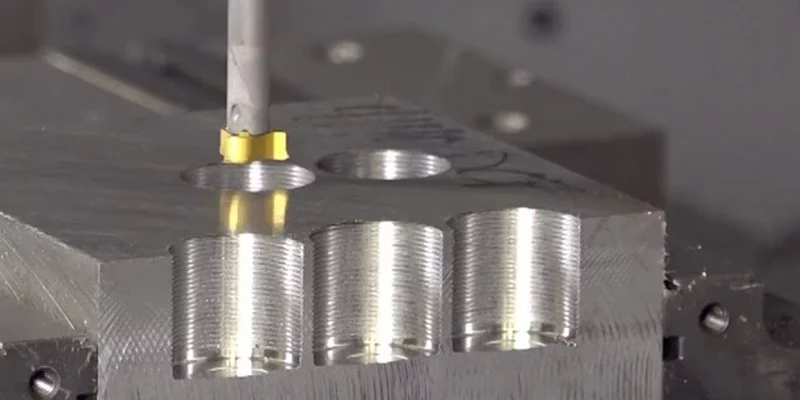
In advanced manufacturing environments, the demand for complex fasteners with exceptional accuracy, durability, and geometric consistency is growing rapidly. Industries such as aerospace, petrochemical engineering, defense, medical devices, and high-performance automotive engineering depend on fasteners that can withstand extreme stress, corrosive environments, and precise mechanical loads. Precision thread milling has emerged as an essential machining method capable of producing high-quality internal and external threads with outstanding control over form, tolerances, and surface integrity. Unlike tapping—where the tool size defines thread geometry—thread milling offers remarkable flexibility, enabling manufacturers to create various thread sizes, pitches, and profiles with a single cutter. This advantage is especially important for complex fasteners with multi-start threads, non-standard dimensions, or difficult-to-machine materials. As CNC machining technology evolves, modern thread milling strategies allow manufacturers to achieve superior repeatability, improved chip control, and enhanced tool life while maintaining high-speed production cycles.
Thread milling’s superiority begins with its ability to produce consistent, burr-free threads, even in hardened alloys and high-strength materials such as titanium, Inconel, stainless steel, tool steel, and exotic superalloys. These materials pose significant challenges for traditional tapping due to high cutting forces and the risk of tool breakage. Thread milling, by contrast, uses a circular interpolation technique that reduces axial cutting loads and allows chips to break gradually. This minimizes heat buildup inside the thread cavity and prevents the galling or tearing commonly seen in aggressive tapping operations. Multi-row helical cutters, solid carbide thread mills, and indexable insert systems further enhance performance by optimizing cutting geometry for low resistance. Manufacturers benefit from cleaner threads, longer tool life, and improved dimensional integrity, particularly when machining small or deep internal threads where chip evacuation and tool stability are critical. These advantages make thread milling an ideal choice for producing precision fasteners where failure tolerance is extremely low.
To enhance accuracy and repeatability, modern CNC machining centers rely heavily on advanced CAM software capable of generating optimized thread milling toolpaths. These software solutions use algorithms that automatically calculate lead-in and lead-out movements, cutter compensation, and radial offset adjustments based on thread profile and material hardness. A key strategy is trochoidal circular interpolation, which combines smooth arcs with controlled radial-step movements to minimize tool pressure and reduce vibration. For multi-start threads or variable-pitch designs, CAM systems can synchronize cutter engagement precisely to maintain uniform pitch spacing and symmetrical thread profiles. In high-precision environments—such as aerospace or medical device production—toolpath verification allows operators to simulate the entire thread milling process, ensuring that tools avoid collision, undercutting, or profile distortion. This digital-first approach reduces trial-and-error adjustments, accelerates production speeds, and ensures that every complex fastener meets specification before machining begins.
Equally important to precision thread milling is the selection of appropriate cutting tools and tooling systems. Solid carbide thread mills are preferred for fine-pitch micro-threading, miniature fasteners, and medical implants, where exceptionally clean thread walls and tight tolerances are required. For large industrial fasteners—such as those used in oil pipelines, structural engineering, or heavy-duty machinery—indexable thread milling cutters provide greater rigidity, deeper reach, and the cost advantage of replaceable inserts. Tool geometry plays a critical role: high-helix angles improve cutting smoothness, while specialized coatings such as TiAlN, AlCrN, and diamond-like coatings offer thermal resistance and extended wear performance. When machining abrasive or hardened materials, coating selection becomes essential to maintaining edge sharpness and preventing micro-chipping. Toolholders also influence final quality; hydraulic chucks, shrink-fit holders, and precision collets ensure minimal runout and maximum rigidity. This synergy between tool geometry, cutter material, coating technology, and toolholding stability directly affects the accuracy, consistency, and longevity of thread milling operations.
Machine stability and process control techniques further enhance performance when machining complex fasteners. Achieving perfect thread geometry requires minimizing vibration, maintaining consistent chip load, and ensuring precise axis synchronization throughout the thread milling cycle. High-speed machining centers equipped with rigid spindle assemblies, thermal compensation systems, and advanced servo control significantly reduce the risk of pitch errors or misalignment. Adaptive control features monitor spindle torque and cutting forces in real time, automatically adjusting feed rates to prevent tool overload—especially valuable when working with deep threads or materials prone to hard spots. Coolant delivery systems play a critical role as well; high-pressure coolant assists in chip evacuation, reduces heat, and improves surface finish. For blind holes, through-tool coolant is especially effective at removing chips from the bottom of the cavity, preventing recutting and ensuring uniform thread quality from top to bottom. These process control innovations contribute to better dimensional accuracy, cleaner thread profiles, and consistent production across high-volume manufacturing runs.
Ultimately, precision thread milling strategies are transforming the production of complex fasteners by offering greater flexibility, tighter tolerances, and superior surface integrity compared to traditional threading methods. As product designs become more specialized and material requirements more demanding, manufacturers must adopt advanced thread milling techniques to ensure durability, reliability, and performance. With the integration of intelligent CAM systems, optimized toolpath routines, high-performance cutting tools, and stable machining platforms, thread milling delivers unmatched control over thread geometry—even for the most challenging applications. This combination of accuracy, efficiency, and versatility positions thread milling as a cornerstone technology for modern industrial fastener production. Manufacturers who master these strategies not only enhance operational efficiency but also achieve the level of precision required to compete in an industry where perfection is not optional—it is the standard.