
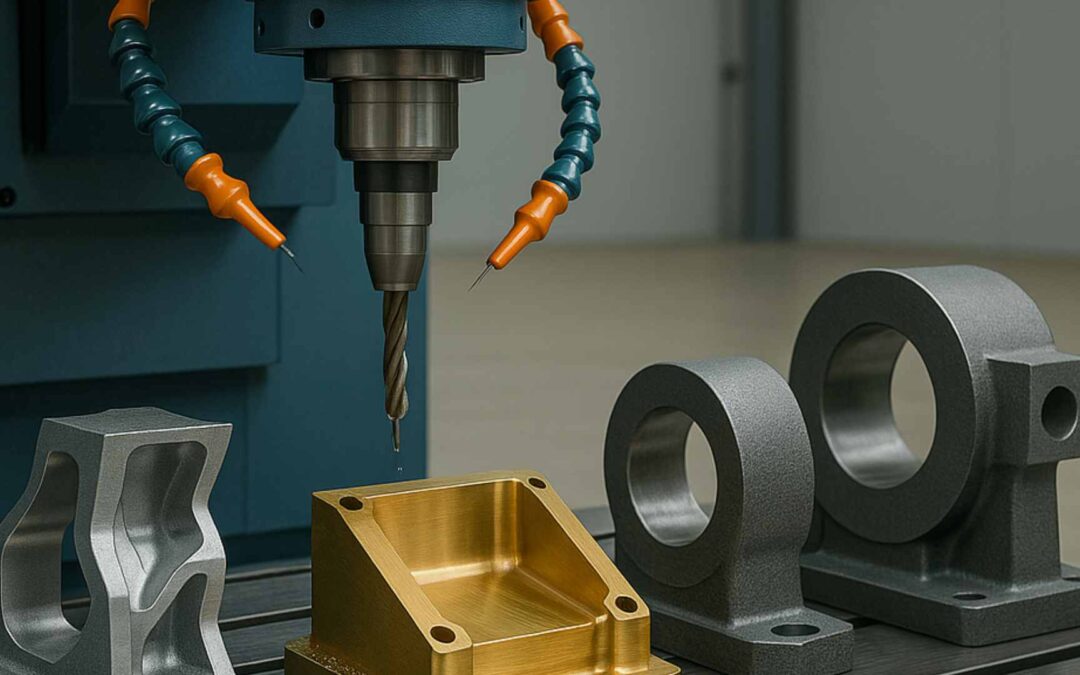
Multi-material CNC tooling for hybrid component production has become a cornerstone of advanced manufacturing as product designs increasingly combine metals, polymers, composites, and specialty alloys within a single functional assembly. Modern industries such as aerospace, automotive, medical devices, renewable energy, robotics, and high-performance electronics all rely on hybrid components that integrate the strength of metals with the lightweight efficiency of polymers or the thermal stability of composites. This shift toward material convergence is driven by the need for improved performance, reduced weight, compact design, thermal optimization, and enhanced durability. However, machining multiple materials within a single production cycle presents formidable technical challenges that go far beyond traditional single-material CNC operations. Each material behaves differently under cutting forces, heat generation, and chip formation, requiring highly adaptive tooling strategies, machine platforms, and process controls. Multi-material CNC tooling bridges this gap by enabling consistent precision across dissimilar materials without sacrificing productivity or surface integrity. From machining titanium bonded to carbon fiber composites in aerospace structures to combining aluminum, stainless steel, and engineering plastics in medical housings, multi-material tooling enables seamless transitions between materials while maintaining tight tolerances and repeatability. As hybrid component production continues to expand globally, CNC tooling systems are evolving into highly specialized, intelligent, and material-adaptive solutions that redefine what is possible in modern manufacturing.
At the core of successful multi-material CNC machining lies advanced tooling design engineered specifically for variable material behavior. Unlike conventional tooling that is optimized for a single substrate, multi-material CNC tools must maintain cutting performance across materials with vastly different hardness, thermal conductivity, elasticity, and chip formation characteristics. Solid carbide tools with ultra-fine grain structures are widely used as a baseline due to their stiffness and edge retention, but they are often enhanced with advanced multi-layer coatings such as aluminum titanium nitride, titanium silicon nitride, diamond-like carbon, or polycrystalline diamond depending on the targeted material range. For example, metals such as aluminum and copper benefit from low-friction diamond coatings that prevent built-up edge formation, while hardened steels and superalloys require high-thermal-resistance coatings to withstand extreme cutting temperatures. Tool geometry must also balance conflicting requirements, as aggressive rake angles that work well for soft polymers may cause edge instability in high-strength alloys. As a result, modern multi-material tooling often uses hybrid edge geometries that combine reinforced cutting edges with optimized rake profiles to minimize cutting force variation during material transitions. Tool holders further contribute to system performance, with shrink-fit and hydraulic holders providing the precise concentricity and vibration damping required to maintain stable cutting conditions when the tool transitions from a compliant polymer into a rigid metal layer within the same toolpath.
Machine tool architecture plays a decisive role in enabling reliable multi-material CNC tooling performance. Hybrid components often require rapid changes in spindle speed, feed rate, and cutting force as the tool encounters different materials within a single operation. High-performance CNC machining centers designed for multi-material production feature wide torque-band spindles capable of stable operation at both high and low speeds without loss of accuracy. Linear motor drives, high-resolution encoders, and advanced motion control algorithms ensure that axis positioning remains precise even under fluctuating cutting loads. Machine rigidity is essential, as transitions between soft and hard materials can generate shock loads that induce vibration or tool chatter if the machine structure lacks sufficient damping. Thermal stability is equally critical, especially when machining metals with low thermal conductivity bonded to temperature-sensitive polymers or adhesives. Advanced CNC platforms incorporate thermal compensation systems, coolant temperature regulation, and fully enclosed work envelopes to maintain environmental stability throughout long hybrid machining cycles. Without these capabilities, the dimensional accuracy of hybrid components becomes highly unpredictable due to cumulative thermal drift, vibration amplification, and uneven material removal rates across bonded interfaces.
Toolpath strategy and CNC programming methodology are among the most influential factors in successful multi-material tooling applications. Conventional machining strategies designed for uniform materials are often unsuitable for hybrid structures where tool engagement conditions change dynamically. Advanced CAM software enables material-aware toolpaths that automatically adjust feed rates, spindle speeds, depth of cut, and step-over values as the tool transitions between dissimilar materials. Constant engagement milling strategies, trochoidal paths, and adaptive clearing techniques are widely used to stabilize cutting forces and prevent sudden load spikes that can damage tools or delaminate bonded layers. In hybrid assemblies that include composites, special attention must be given to fiber orientation and resin content to avoid fiber pull-out, delamination, or edge fraying. Entry and exit strategies become critical at material interfaces, as abrupt cutting engagement can generate micro-cracks in brittle layers or induce residual stress in metals. Multi-axis CNC machining further enhances control by allowing optimal tool orientation for each material layer, minimizing contact area and improving chip evacuation efficiency. Real-time adaptive control systems monitor spindle load, vibration signatures, and cutting temperature, dynamically fine-tuning machining parameters to maintain consistent performance across material boundaries. These intelligent programming strategies transform multi-material machining from a high-risk process into a predictable, stable, and scalable production solution.
Cooling and lubrication strategies represent one of the most complex aspects of multi-material CNC tooling due to the radically different thermal and chemical behavior of metals, polymers, and composite materials. Metals typically tolerate aggressive flood cooling and high-pressure through-spindle coolant delivery, which aids in heat dissipation and chip evacuation. However, polymers and composite matrices can be highly sensitive to thermal shock, chemical attack, or excessive coolant absorption that leads to swelling, softening, or surface degradation. This creates a critical balancing act in hybrid machining environments where both thermal management and material protection must be achieved simultaneously. Minimum quantity lubrication systems are often deployed to reduce friction in metal cutting while minimizing fluid exposure on polymer surfaces. In more demanding applications, dual-zone coolant delivery systems are used to apply targeted cooling only where it is needed, preserving the integrity of sensitive material layers. Cryogenic cooling is increasingly adopted for metal-dominant hybrid components, particularly in aerospace and energy applications, as it dramatically lowers cutting temperatures without introducing liquid contamination that could compromise bonded interfaces. Effective thermal control ensures not only extended tool life and stable cutting performance but also preserves the mechanical, chemical, and dimensional properties of all materials within the hybrid component.
Surface integrity, interface precision, and dimensional stability are the ultimate quality benchmarks in multi-material CNC hybrid component production. Hybrid assemblies often rely on precise material interfaces to achieve their intended performance, whether it is electrical insulation between conductive layers, thermal isolation between heat-generating components, or mechanical bonding between structural elements. Any surface tearing, micro-cracking, or delamination at these interfaces can lead to premature failure in service. Achieving optimal surface quality across dissimilar materials requires finely tuned finishing strategies that balance cutting force, thermal input, and tool condition. Ultra-light finishing passes with controlled feed rates and stabilized spindle speeds are used to minimize residual stress and preserve interface adhesion. Tool wear monitoring becomes especially critical, as worn cutting edges tend to generate uneven cutting forces that disproportionately affect softer materials and interface regions. In-process probing systems verify dimensional accuracy and interface alignment during machining, while post-process inspection using coordinate measuring machines, laser scanning, ultrasonic testing, and infrared thermography ensures that both geometric and material integrity specifications are fully met. In regulated industries such as aerospace, medical, and defense manufacturing, full digital traceability of tooling parameters, material batch data, and inspection results is required to maintain compliance with global quality standards. Multi-material CNC tooling therefore operates within a tightly controlled quality ecosystem where machining precision, material science, and digital metrology converge.
The future of multi-material CNC tooling for hybrid component production is being driven by rapid advances in artificial intelligence, digital simulation, additive-subtractive hybrid manufacturing, and smart factory integration. AI-driven CNC systems are now capable of analyzing real-time cutting force data, vibration patterns, temperature distribution, and tool wear behavior to autonomously adjust machining parameters across material transitions. Digital twins of hybrid machining processes allow engineers to simulate bonding behavior, thermal flow, tool deflection, and interface stress before physical production begins, drastically reducing development time and minimizing costly trial runs. The convergence of CNC machining with additive manufacturing further expands hybrid production possibilities, enabling manufacturers to 3D print complex multi-material preforms and then apply high-precision CNC finishing using adaptive multi-material tooling strategies. Robotic automation and flexible manufacturing cells allow continuous, unattended production of hybrid components with exceptional consistency across large production volumes. As industries continue to demand lighter, smarter, more compact, and more functionally integrated products, multi-material CNC tooling will no longer be a niche capability but a foundational production technology. Manufacturers that invest in intelligent tooling systems, adaptive CNC platforms, advanced cooling strategies, and data-driven quality control will secure a decisive competitive advantage in the rapidly evolving world of hybrid component manufacturing.